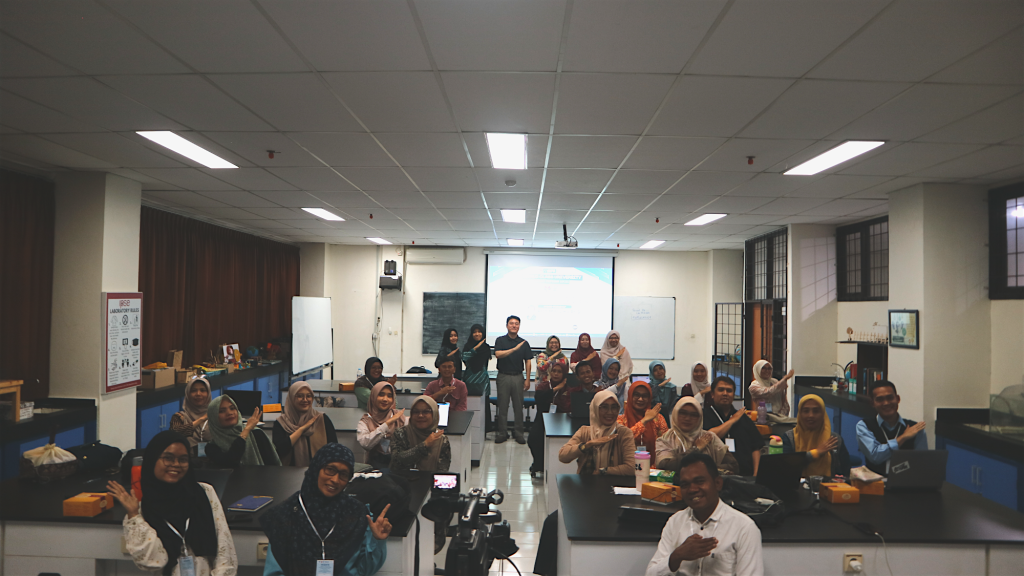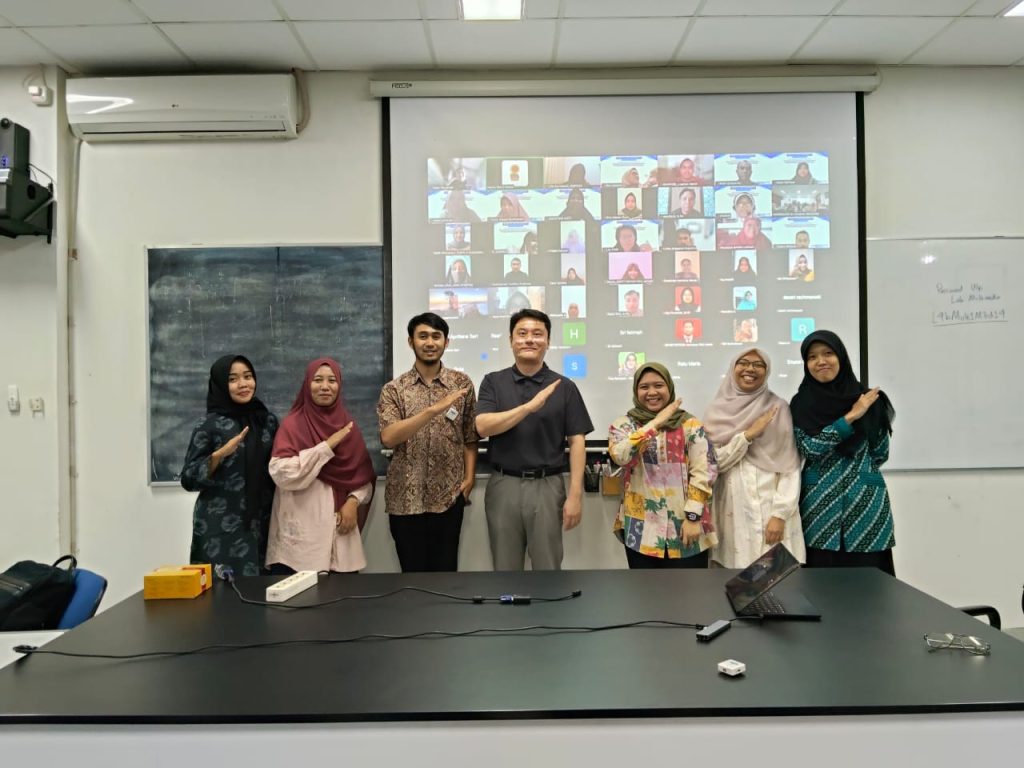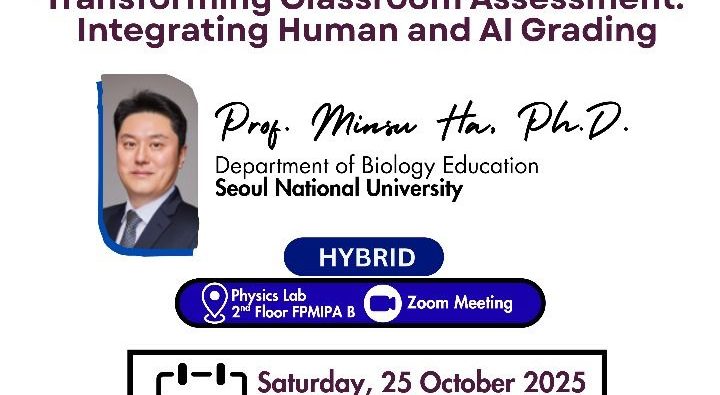
The Science Education Study Program, Faculty of Mathematics and Science Education (FPMIPA), Universitas Pendidikan Indonesia continues to strengthen its international collaborations in an effort to enhance the professionalism and capacity of science teachers in Indonesia. One of the key initiatives under this commitment was the Workshop for Science Teachers titled “Transforming Classroom Assessment: Integrating Human and AI Grading”, held on Saturday, October 25, 2025, at FPMIPA Building B, UPI Bandung.
This workshop was part of the Adjunct Professor Program under UPI’s World Class University (WCU) initiative, featuring Prof. Minsu Ha, Ph.D., from the Department of Biology Education, Seoul National University (SNU), South Korea. As one of the world’s top universities—ranked 38th globally in the QS World University Rankings 2026—SNU’s collaboration with UPI marks an important milestone in expanding global academic engagement and knowledge exchange.
Conducted in a hybrid format, the workshop brought together 27 teachers of science, chemistry, physics, and biology attending onsite from Bandung, Cirebon, and Sukabumi, along with around 86 online participants from various regions across Indonesia.
In the first session, moderated by Ai Nurlaelasari Rusmana, M.Ed., lecturer of Science Education UPI, Prof. Ha emphasized the importance of open-ended assessment as a tool to measure students’ conceptual understanding in depth. He also addressed the challenges teachers face in implementing such assessments, including workload and concerns about scoring fairness. “Artificial Intelligence should serve as a partner to teachers in assessment—not as a replacement,” said Prof. Ha.
During his presentation, Prof. Ha introduced SAAI (Scoring Assistant using Artificial Intelligence), a web-based platform developed by his research team in South Korea. The system helps teachers conduct semi-automated scoring of open-ended responses while ensuring that the teacher retains final authority over grading decisions—balancing efficiency and fairness in the evaluation process.
The second session, facilitated by Hanna Nurul Husna, M.Pd., guided participants through a hands-on practice using SAAI with examples of student responses in Indonesian. Both onsite and online participants showed great enthusiasm as they explored how AI could support teachers in analyzing and interpreting student answers.
At the closing session, Prof. Ha expressed his interest in continuing collaboration with UPI to develop an Indonesian version of SAAI, enabling broader access and applicability for teachers across Indonesia. “International collaboration is vital to building fair, relevant, and sustainable assessment systems for the future of education,” he stated.
The workshop marked the final event of Prof. Ha’s visit to Indonesia as an Adjunct Professor at Science Education UPI. His visit also included collaborative teaching, focus group discussions with UPI lecturers, and a general lecture for science education students. Through this international engagement, UPI reaffirms its position as a world-class university committed to empowering teachers, advancing assessment innovation, and strengthening the global competitiveness of science education in Indonesia.