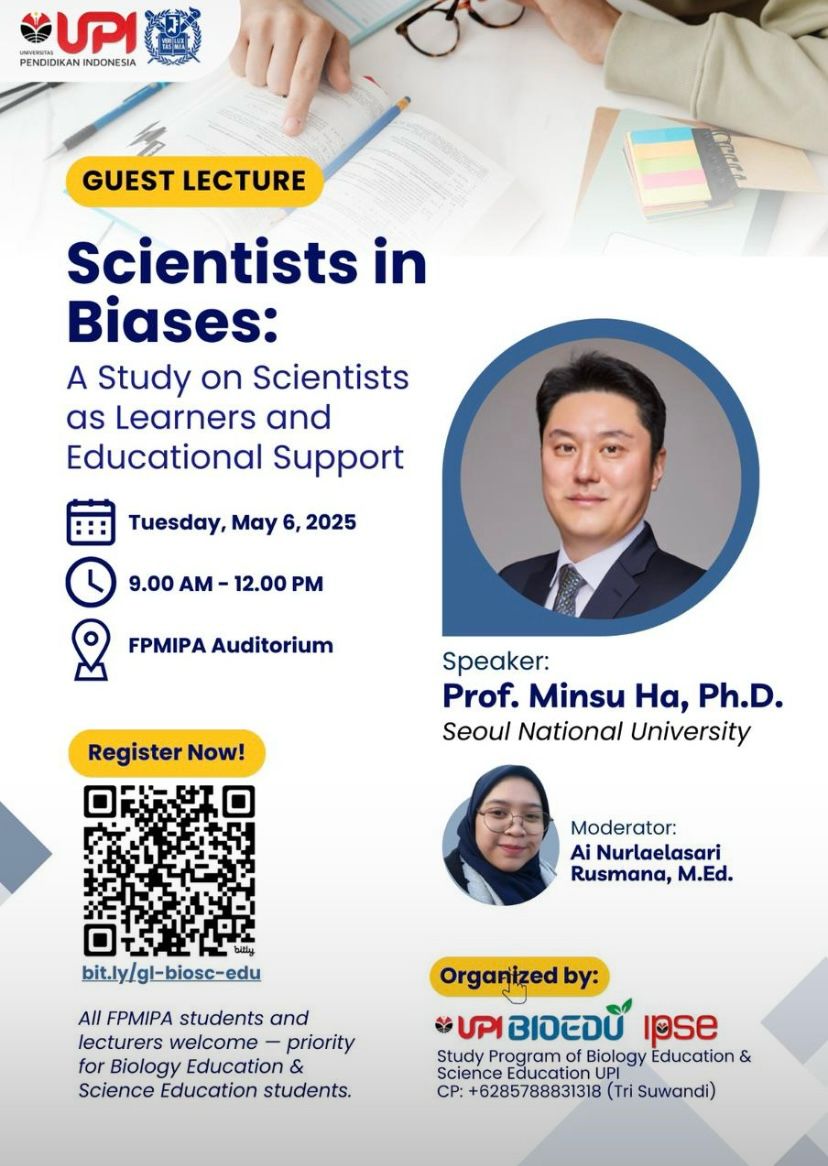
Bandung, May 6, 2025 — The Auditorium of FPMIPA UPI became the venue for a compelling guest lecture by Prof. Minsu Ha from Seoul National University, titled “Scientists in Biases: A Study on Scientists as Learners and Educational Support.” Held from 09.00 to 12.00, the session was attended by students and lecturers from various programs within the Faculty of Mathematics and Science Education. The lecture delved into the often-overlooked subject of cognitive biases in scientific practice, offering fresh insights into how scientists—despite their training in logic and objectivity—are not immune to cognitive pitfalls.
During the lecture, Prof. Ha revealed that while collaboration is widely considered a strength in scientific research, it can paradoxically amplify biases such as overconfidence, planning fallacy, sunk cost fallacy, the bandwagon effect, and authority bias. These can create a “fallacy cascade” within group dynamics, undermining decision-making and creativity. To counter these challenges, he revisited the foundational principles of scientific conduct—the Mertonian Norms: Communism, Universalism, Disinterestedness, and Organized Skepticism—as a guide to maintaining integrity in research.
A key highlight was the introduction of the KAAR Model—Knowledge, Awareness, Action, and Reflection—which Prof. Ha developed to help scientists recognize and manage bias in themselves and their teams. He also shared a set of educational materials, including reflective checklists designed to enhance bias-awareness and promote empathy among researchers. His closing message emphasized that scientists are lifelong learners, and being open to self-reflection and continuous improvement is essential to advancing both individual and collaborative scientific endeavors.