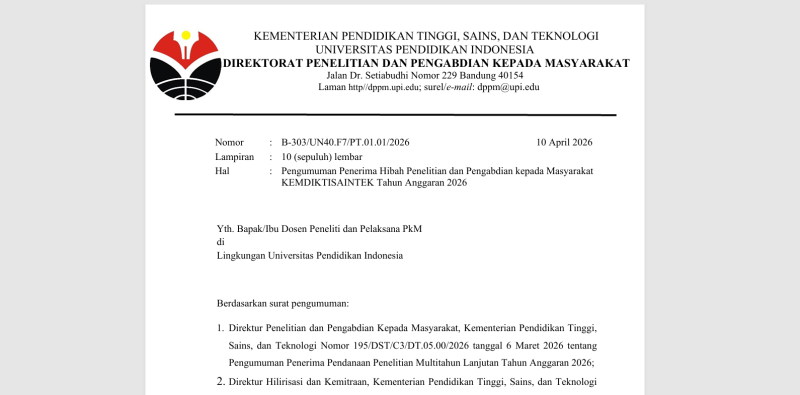
The Science Education Study Program at Universitas Pendidikan Indonesia (UPI) proudly announces a series of outstanding achievements by its lecturers who have successfully secured funding under the BIMA (Research and Community Service Program) from the Ministry of Education, Culture, Research, and Technology.
This achievement reflects the strong research capacity, innovation, and commitment of Science Education lecturers in advancing education, sustainability, and technology-integrated learning.
Doctoral Dissertation Research (Penelitian Disertasi Doktor)
Several professors have been awarded funding for doctoral-level research, focusing on innovative and impactful educational approaches:
- Prof. Dr. Parlindungan Sinaga, M.Si.
Pengembangan Strategi Perkuliahan Mekanika Klasik Berdiferensiasi Berbasis Multi-Representasi Statis dan Dinamis (MeKlas-DMRSD) untuk Meningkatkan Keterampilan Berpikir Kritis dan Divergen - Prof. Dr. Andi Suhandi, M.Si.
Pengembangan Solar Cells Bifocal Modeling Tools (SoBiMoT) Serta Implementasinya dalam Pembelajaran Fisika Berorientasi Peningkatan Literasi Energi Terbarukan Siswa SMA - Prof. Dr. rer. nat. Adi Rahmat, M.Si.
Pengembangan Program Biologi Dasar Flipped Authentic Inquiry berbantuan Metacognitive Self-System Regulation untuk Meningkatkan Performa Holistik dan Kesejahteraan Mental Mahasiswa - Dr. Eng. Agus Setiawan, M.Si.
Pengembangan Program Perkuliahan Fisika Lingkungan berbasis Transformative Project-based Learning untuk Meningkatkan Literasi Lingkungan, dan Keterampilan Berpikir Kreatif Mahasiswa - Prof. Dr. Nahadi, M.Si., M.Pd.
Inovasi Praktikum Pengolahan Air Berbasis Membran Nanofiltrasi Terintegrasi STEM-ESD untuk Meningkatkan Berpikir Kritis, Sustainability Awareness dan Kemampuan merancang Praktikum Mahasiswa - Prof. Dr. Andi Suhandi, M.Si.
STeCU-IoT: Sistem Cerdas Pengukuran Cuaca Otomatis Berbasis IoT untuk Perkuliahan IPBA Berorientasi Peningkatan Literasi Iklim dan Kemampuan Analisis Data Mahasiswa - Prof. Dr. Parlindungan Sinaga, M.Si.
Pengembangan Strategi Perkuliahan Fisika Kuantum Berbasis Computational Thinking (FIKU-CT) untuk Meningkatkan Keterampilan Berpikir Kritis dan Pemecahan Masalah Kreatif Mahasiswa - Prof. Dr. Riandi, M.Si.
Pengembangan Program Perkuliahan Biologi Umum berbasis RADEC for Sustainable Development untuk Meningkatkan System Thinking dan Sustainability Awareness
Master’s to Doctoral Acceleration Program (PMDSU)
The program also secured funding under the Magister menuju Doktor untuk Sarjana Unggul (PMDSU) scheme:
- Prof. Dr. Riandi, M.Si.
Menangani Kecemasan Ujian Sains Siswa SMP melalui Pelatihan Berbasis Metaafektif berbantuan Kecerdasan Buatan - Prof. Dr. rer. nat. Ahmad Mudzakir, M.Si.
Aktivitas Perekayasaan Molekul pada Perkuliahan Kimia berbasis Penelitian untuk Meningkatkan Literasi Keberlanjutan Mahasiswa melalui Pembelajaran Berpikir Sistem - Prof. Topik Hidayat, M.Si., Ph.D.
Pengembangan Modul Ajar Citizens Science Project Terintegrasi Kearifan Lokal Lampung Materi Perubahan Lingkungan untuk Melatih Literasi Lingkungan, Digital, dan Numerasi SMA - Dr. Achmad Samsudin, M.Pd.
Pengembangan Refutation-Texts berbantuan Augmented Reality (RefTaR) untuk Mengurangi Miskonsepsi, Conceptual Change, Cognitive-Psychological Model, Demeanor with Physics Peserta Didik
Fundamental Research – Regular Scheme
- Prof. Dr. Riandi, M.Si.
Rancang Bangun Artificial Intelligence-Powered E-Learning dengan Model Adaptif Technological Pedagogy Content Knowledge untuk Meningkatkan Kecerdasan Ekopedagogi dalam Mendukung Pendidikan Berkelanjutan
Beginner Lecturer Research (Penelitian Dosen Pemula)
- Riana Nurismawati, M.Pd.
Pengembangan E-Modul Praktikum berbasis Arduino-Tinkercad: Kombinasi Eksperimen Virtual dan Fisik pada Pembelajaran STEM Mahasiswa Pendidikan IPA
Community Partnership Empowerment (PKM)
In addition to research, lecturers also secured funding for community service programs:
- Prof. Dr. Diana Rochintaniawati, M.Ed.
Meningkatkan Kemampuan guru dalam Mengembangkan dan Mengimplementasikan Pembelajaran IoT Terintegrasi STEM pada Tema Pencemaran Tanah Melalui Kegiatan Pelatihan - Ai Nurlelasari Rusmana, M.Ed.
Pengembangan Profesionalisme Guru IPA Kota Cirebon melalui Pelatihan STEM Terintegrasi KKA (Koding dan Kecerdasan Artifisial) Berbasis Potensi Lokal
These achievements demonstrate the strong commitment of the Science Education Study Program in contributing to educational innovation, research excellence, and community empowerment. The diversity of funded projects highlights interdisciplinary approaches, ranging from artificial intelligence, IoT, sustainability education, to STEM-based learning innovations.
The program extends its highest appreciation to all lecturers for their dedication and contributions. It is expected that these research and community service projects will generate significant impacts on education quality, scientific advancement, and sustainable development in Indonesia.