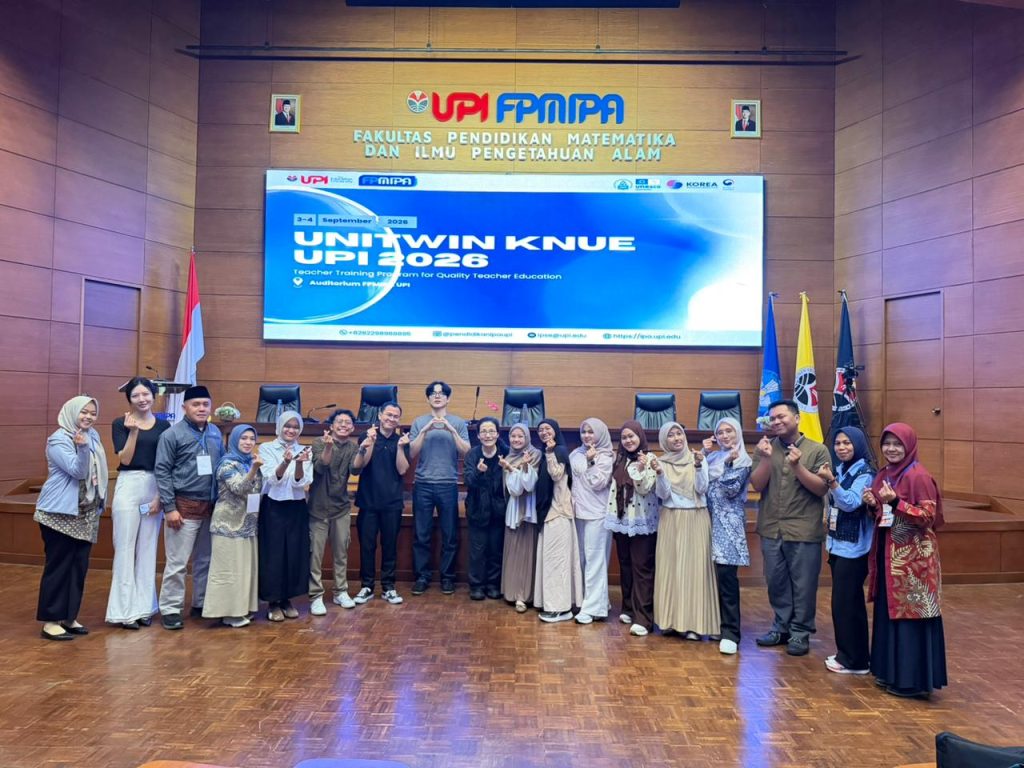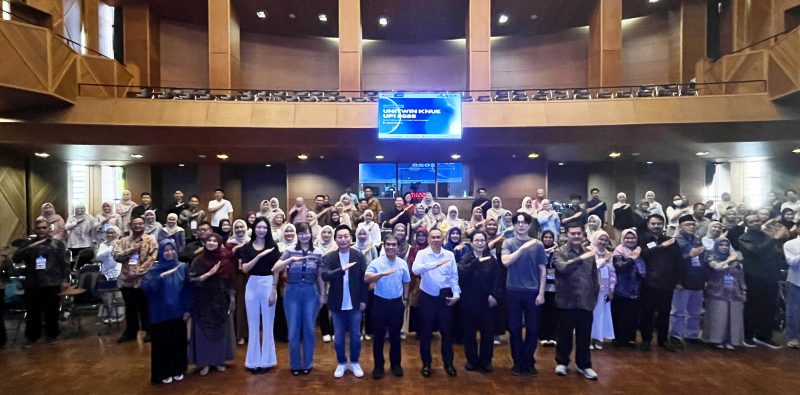
Bandung, 3-4 September 2026 – The Faculty of Mathematics and Science Education (FPMIPA), Universitas Pendidikan Indonesia (UPI), partnered with Korea National University of Education (KNUE) and the UNESCO University Twinning and Networking Programme (UNITWIN) to hold an international teacher training program for Teacher Education titled “Preparing Future-Ready Science Teachers: Integrating Engineering Design Process and Generative AI for STEM Learning, Scientific Argumentation, and Assessment in ESD Context.”
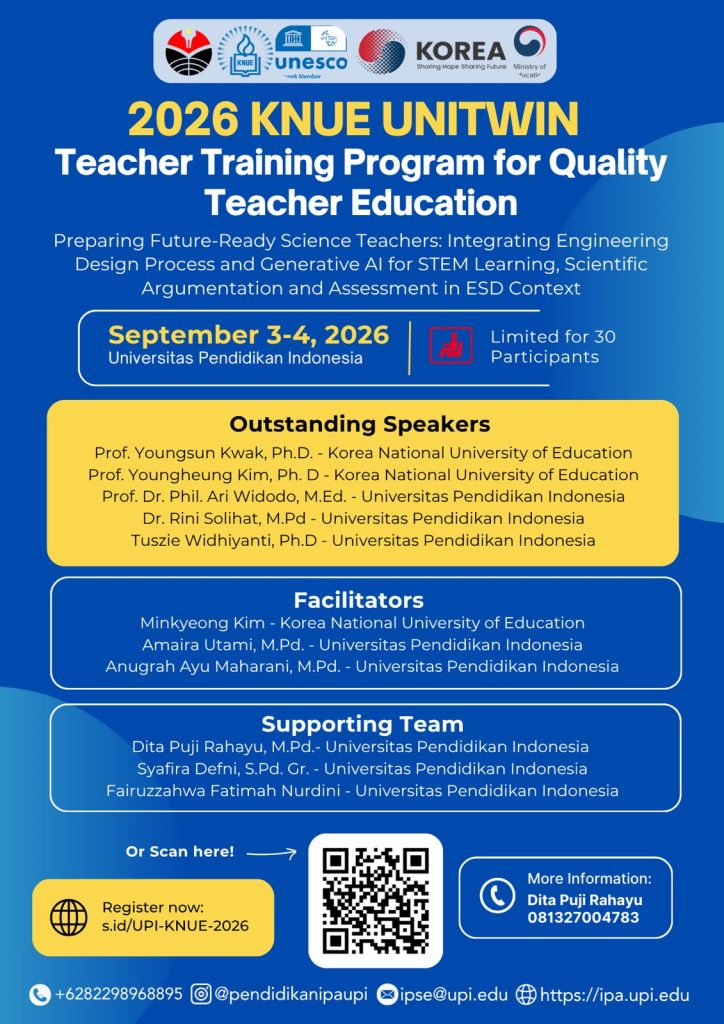
The two-day program ran in a hybrid format and reached 121 junior high school science teachers. Thirty attended in person at the FPMIPA UPI Auditorium, and 91 joined online via Zoom. Invitations went out through the science teachers’ subject forum (MGMP IPA) and personal networks, which drew participants from a wide range of schools.
The training was led by a UPI team chaired by Prof. Dr. phil. Ari Widodo, M.Ed., with Dr. Rini Solihat, M.Pd., Tuszie Widhiyanti, Ph.D., Amaira Utami, M.Pd., and Anugrah Ayu Maharani Widianingsih, M.Pd. Undergraduate, master’s, and doctoral students from Science Education, Biology Education, and Chemistry Education supported the event.
Day 1: Generative AI, Deep Learning, and ESD
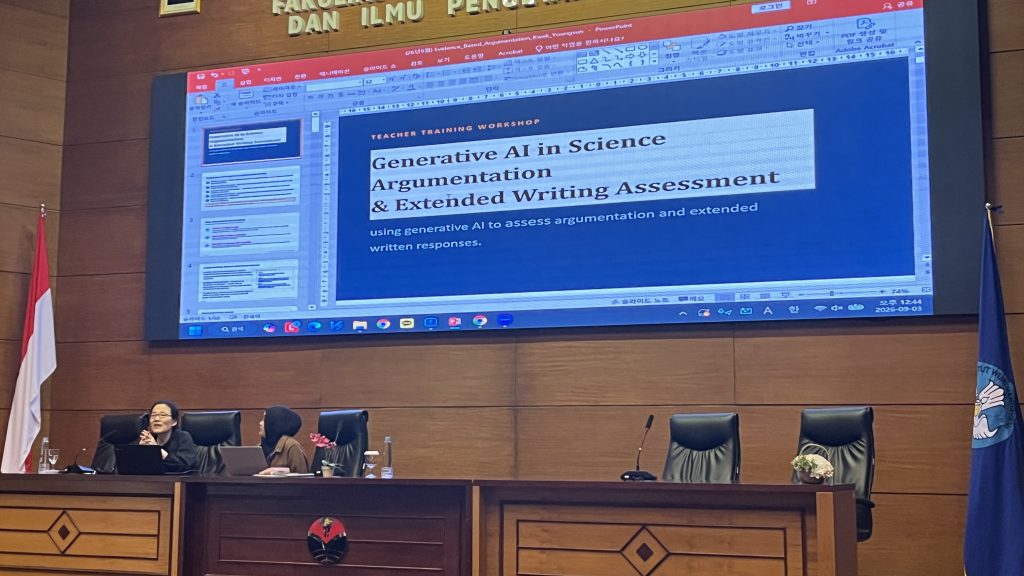
The program opened with a pretest prepared by the KNUE team, which participants accessed through a QR code at registration. Prof. Youngsun Kwak, Ph.D. of KNUE then delivered the first session, Generative AI for Assessing Scientific Argumentation Activities. She explored how AI tools can help teachers evaluate the quality of students’ scientific reasoning more efficiently and consistently.
Prof. Ari Widodo followed with a session connecting deep learning, STEM, and Education for Sustainable Development (ESD). He highlighted the three principles of deep learning: meaningful, mindful, and joyful learning. He stressed that well-designed lessons should help students not only understand concepts but also apply them and reflect on what they have learned. The discussion that followed was lively, with many teachers asking how generative AI could be used responsibly in their own science classrooms.
Day Two: From Engineering Design to Lesson Plans
The second day moved from ideas to practice. Prof. Young-Heung Kim, Ph.D. of KNUE presented Understanding and Applying the Engineering Design Process in STEM Lesson Planning. He showed how the cycle of defining problems, designing, testing, and improving solutions can anchor meaningful STEM learning. Teachers then took part in a hands-on activity in which they used generative AI to design student worksheets.
Dr. Rini Solihat and Tuszie Widhiyanti closed the program with a practical session on lesson plan ideas. They guided participants in developing classroom-ready designs that combine the engineering design process, scientific argumentation, and sustainability themes.
Enthusiasm ran high throughout both days. For many participants, this was their first international-level training, and some found the English-language sessions challenging. The organizers noted that the strong collaboration between UPI, KNUE, and UNITWIN, together with support from the FPMIPA leadership and the dedication of the lecturer and student committee, was key to the program’s success.
The impact is meant to extend beyond the two days. Each participant is expected to share and apply what they learned with fellow teachers at their own school, spreading the ideas more widely across science education.
The program reflects UPI’s commitment to community service under the Tri Darma of higher education. It also strengthens the long-standing partnership between UPI, KNUE, and UNESCO UNITWIN in advancing the professional development of science teachers in Indonesia and beyond.