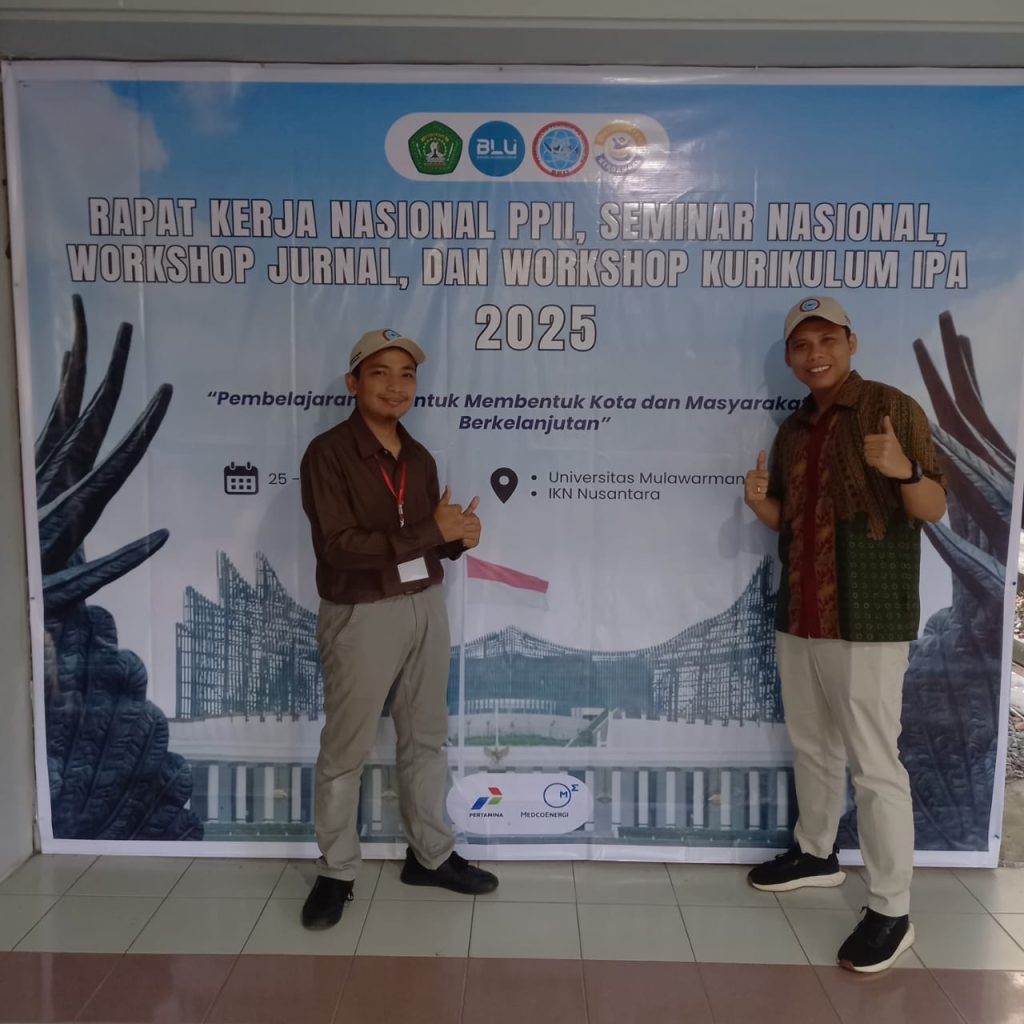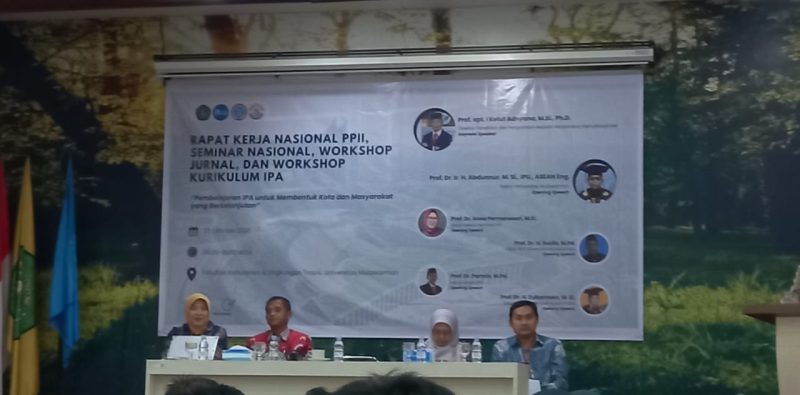
Bandung, October 28, 2025 — The Indonesian Association of Science Education (PPII) successfully held the National Coordination Meeting (Rakornas) and National Seminar at Universitas Mulawarman, Samarinda, bringing together science education leaders, lecturers, and researchers from across the country. Representing Universitas Pendidikan Indonesia (UPI) was Eka Cahya Prima, who joined the national discussion forum to strengthen the direction and collaboration of science education programs across Indonesia.
This year’s Rakornas focused on formulating a national graduate profile framework for undergraduate programs (S1) in Science Education, led by Prof. Dr. Parmin, M.Pd. (Chair of PPII), R. Ahmad Zaky El Islami, Ph.D. (PPII Secretary General), Prof. Dr. Lia Yuliati, M.Pd., and Dr. Fidia Fibriana, M.Sc.. The framework aims to unify the identity, competencies, and academic direction of science education graduates in Indonesia, aligning with the Indonesian National Qualifications Framework (KKNI) Level 6 and the demands of the 21st century.
Through presentations and discussions, participants emphasized that Science Education graduates should not only master pedagogical and scientific knowledge but also be technologically adaptive, reflective, and grounded in local culture and sustainability values. The session also explored how the Body of Knowledge (BoK) for Science Education could integrate modern learning approaches such as AI, AR/VR, STEM, and digital pedagogy, while maintaining flexibility for local institutional contexts.
The event also featured academic collaboration dialogues among member universities, highlighting shared efforts in curriculum renewal, research innovation, and professional teacher development in the era of digital transformation.
UPI’s participation through Eka Cahya Prima reflects its active role in national science education policymaking, as well as its commitment to supporting PPII’s mission of strengthening science education quality and research synergy across Indonesia.
The Rakornas and Seminar reaffirmed PPII’s vision to advance science education that is humanistic, sustainable, and globally relevant—while rooted in Indonesia’s local wisdom.